

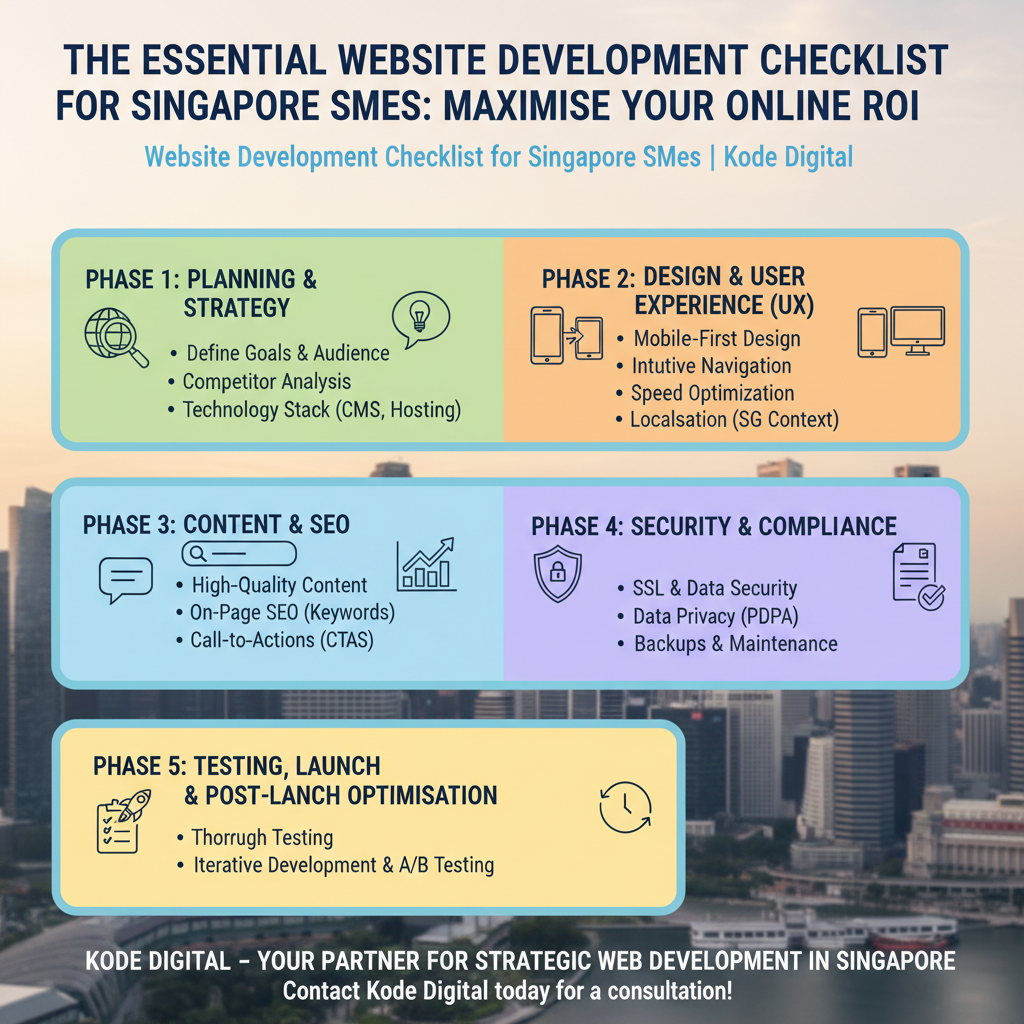
The Essential Website Development Checklist for Singapore SMEs: Maximise Your Online ROI
Singapore’s vibrant digital landscape offers immense opportunities for Small and Medium-sized Enterprises (SMEs) to thrive. In this competitive environment, a professionally developed website is no longer a luxury but a fundamental necessity. It serves as your 24/7 storefront, your primary communication channel, and a powerful engine for growth. But merely having a website isn’t enough; to truly maximise your online Return on Investment (ROI), your site needs to be strategically planned, expertly developed, and continuously optimised.
At Kode Digital, we understand the unique challenges and opportunities faced by Singaporean businesses. This comprehensive checklist will guide you through the essential considerations for developing a website that not only looks good but also performs exceptionally, drives traffic, engages your audience, and converts visitors into loyal customers.
Why a Strategic Website Matters for Singapore SMEs
Beyond a Digital Business Card
Many businesses still view their website as a static online brochure. A truly effective website, however, is a dynamic sales and marketing tool, an interactive platform designed to achieve specific business objectives like generating leads, selling products, or building brand authority. For Singapore SMEs, a strategic website leverages digital technology to scale operations and reach a wider audience, an investment that yields significant returns when done right.
The Competitive Edge in Singapore’s Digital Landscape
Singapore is a highly connected nation, with a digitally savvy population that expects seamless online experiences. To stand out amidst the fierce competition, your website needs to offer more than just basic information. It must be fast, secure, easy to navigate, and deliver tangible value to your visitors. A well-developed website differentiates your brand, builds credibility, and enables you to compete effectively with larger players by providing a superior user journey. It’s how you capture attention and maintain relevance in a crowded digital marketplace.
Phase 1: Planning & Strategy – Laying the Foundation
Before a single line of code is written or a design mock-up created, thorough planning is paramount. This foundational phase dictates the success of your entire website project.
Defining Your Goals and Audience
What are your website’s goals? Clear, measurable objectives (e.g., increased sales, lead generation, email list growth) will inform every development decision. Crucially, understand your target audience in Singapore: their pain points, preferences, and online behaviours. This insight shapes content, design, and UX, making a mobile-first strategy critical if they primarily use smartphones.
Competitor Analysis and Market Trends
Research your local and international competitors. What are they doing well? Where are their gaps? Identifying opportunities and pitfalls can help you refine your unique selling proposition (USP) and avoid common mistakes. Stay abreast of Singapore-specific market trends, consumer habits, and technological advancements. This proactive approach ensures your website remains relevant and cutting-edge.
Choosing the Right Technology Stack (CMS, Hosting)
The underlying technology of your website is crucial for its performance, scalability, and ease of management.
- Content Management System (CMS): Select a CMS (e.g., WordPress, Shopify, HubSpot CMS) that aligns with your technical capabilities, budget, and future growth plans. Consider factors like ease of content updates, available integrations, and security features.
- Hosting: Opt for reliable web hosting that offers excellent uptime, fast load speeds, and robust security. For Singapore businesses, a local hosting provider or a Content Delivery Network (CDN) with servers in Asia can significantly improve site speed for local users.
Phase 2: Design & User Experience (UX) – Engaging Your Visitors
A visually appealing website is important, but a functional, user-friendly one is invaluable. UX design focuses on creating a seamless and enjoyable experience for your visitors, encouraging them to stay longer and interact more.
Mobile-First and Responsive Design
With the pervasive use of smartphones in Singapore, a mobile-first approach is no longer optional. Your website must adapt flawlessly to any screen size – from desktops to tablets to smartphones. Prioritise the mobile experience during design and development, ensuring fast loading times, easy navigation, and clear calls-to-action on smaller screens. Google also heavily favours mobile-friendly sites in its search rankings.
Intuitive Navigation and Information Architecture
Visitors should effortlessly find what they’re looking for within a few clicks. Develop a logical and intuitive navigation structure, clear menus, and consistent labelling. A well-organised information architecture (IA) reduces frustration and guides users effectively through your content, leading to higher engagement and conversions.
Speed and Performance Optimisation
In Singapore, where connectivity is generally excellent, users have high expectations for website speed. Slow loading times are a major deterrent, increasing bounce rates and negatively impacting SEO. Optimise images, leverage browser caching, minimise code, and use efficient hosting to ensure your website loads in under 2-3 seconds. Regular performance audits are essential.
Localisation for the Singapore Market
Consider specific elements that resonate with the Singaporean audience. This might include:
- Language options (e.g., English, Mandarin, Malay) if applicable to your target demographic.
- Payment gateways commonly used in Singapore (e.g., PayNow, GrabPay, local bank transfers, major credit cards).
- Content that reflects local culture, holidays, and consumer preferences.
- Clear shipping and delivery information for local addresses.
Phase 3: Content & SEO – Attracting and Converting
A beautiful website without compelling content or visibility is like a shop in a hidden alley. Your content must resonate, and your site must be discoverable.
High-Quality, Relevant Content Strategy
Develop a content strategy that addresses your audience’s needs, answers their questions, and positions your business as an authority. This includes engaging blog posts, informative service pages, compelling product descriptions, testimonials, and strong calls-to-action. Ensure your content is well-written, proofread for British English spelling and grammar, and regularly updated to remain fresh and relevant.
On-Page SEO Essentials for Singapore Searches
Optimising your website for search engines is crucial for organic traffic. Key on-page SEO elements include:
- Keyword Research: Identify relevant keywords and phrases that your Singaporean audience uses when searching for your products or services.
- Title Tags and Meta Descriptions: Craft compelling and keyword-rich titles and descriptions for each page.
- Header Tags (H1, H2, H3): Structure your content logically using headers for readability and SEO.
- Image Optimisation: Use descriptive alt text for images.
- Internal Linking: Link related pages within your site to improve navigation and distribute “link juice.”
Call-to-Actions (CTAs) and Conversion Paths
Every page should have a clear purpose and guide the user towards a desired action. Use compelling CTAs (e.g., “Get a Free Quote,” “Shop Now,” “Download Our Brochure”) that stand out. Design clear conversion paths that minimise friction and make it easy for visitors to complete forms, make purchases, or contact your team.
Phase 4: Security & Compliance – Protecting Your Business and Customers
In an age of increasing cyber threats and data privacy concerns, website security and compliance are non-negotiable. Protecting your customers’ data and your business reputation is paramount.
Data Security and SSL Certificates
Ensure your website uses an SSL certificate (HTTPS) to encrypt data transferred between the user’s browser and your server. This is vital for security, especially for e-commerce sites or those collecting personal information, and it’s also a ranking factor for search engines. Implement robust security measures to protect against malware, hacking attempts, and data breaches.
General Data Privacy Considerations
While we cannot provide legal advice, it is generally prudent for any business operating online in Singapore to be mindful of data privacy principles. This involves being transparent about data collection, storage, and usage, and providing clear privacy policies. Ensure your website development considers these general best practices to build customer trust.
Regular Backups and Maintenance
Preventative maintenance is key to a secure and high-performing website. Implement a schedule for regular website backups, software updates (CMS, plugins, themes), and security patches. This proactive approach minimises downtime and protects your investment.
Phase 5: Testing, Launch & Post-Launch Optimisation – Continuous Improvement
The launch is not the end, but rather the beginning of your website’s journey. Continuous monitoring and optimisation are crucial for sustained success.
Thorough Testing (Functionality, Responsiveness, Speed)
Before going live, rigorously test every aspect of your website. Check all forms, links, payment gateways, and interactive elements. Verify responsiveness across various devices and browsers. Conduct speed tests to ensure optimal performance. User acceptance testing (UAT) with real users can uncover unforeseen issues.
Analytics Setup and Monitoring
Integrate powerful analytics tools (e.g., Google Analytics 4) from day one. This allows you to track key performance indicators (KPIs) such as traffic sources, bounce rates, conversion rates, and user behaviour. Regular monitoring provides invaluable insights for future optimisations.
Iterative Development and A/B Testing
Your website should be a living asset, continuously improved based on data and user feedback. Embrace iterative development by making small, regular enhancements. Utilise A/B testing to compare different versions of pages, CTAs, or design elements to determine what performs best for your Singaporean audience. This data-driven approach ensures your website consistently evolves to meet changing market demands and user expectations.
Beyond the Checklist: Your Website as a Living Asset
Building a high-performing website is an ongoing journey, not a one-time project. By following this comprehensive checklist, Singapore SMEs can lay a robust foundation for online success. However, the digital landscape is constantly evolving. Your website needs continuous attention, updates, and strategic refinements to remain competitive and continue delivering maximum ROI.
Partnering with an experienced web development agency like Kode Digital ensures your website not only meets today’s standards but is also future-proofed for tomorrow’s challenges. We specialise in crafting bespoke, performance-driven websites that help Singapore businesses thrive online.
Ready to build a website that truly drives your business forward? Contact Kode Digital today for a consultation and let us help you transform your online presence.
