

Imagine a thriving e-commerce startup located in Orchard, experiencing rapid growth but struggling with internal chaos. Orders are up, but so are customer service queries about delayed deliveries, teams aren’t communicating effectively, and the founder feels perpetually stuck in operational firefighting. This scenario isn’t unique; it’s a common growing pain for many ambitious enterprises across Singapore.
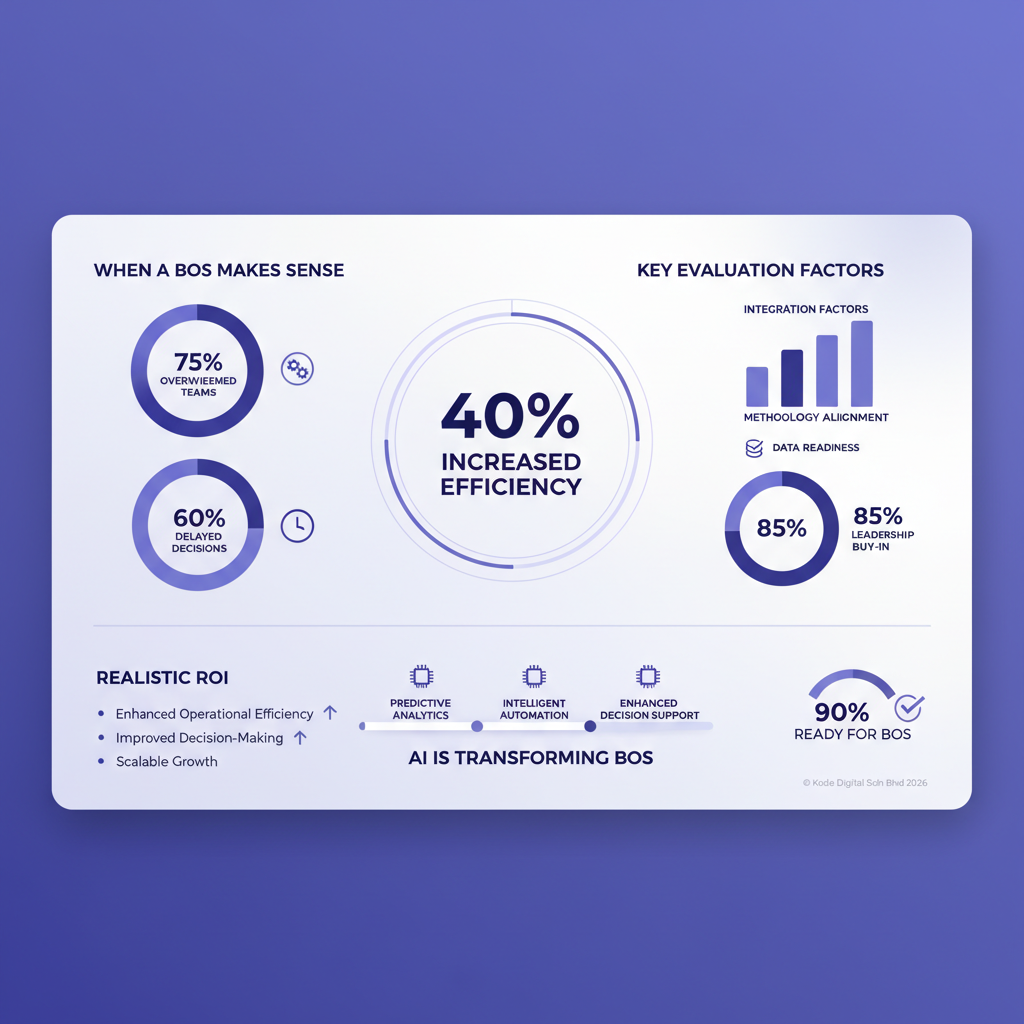
When a Business Operating System (BOS) Makes Sense for Your Singapore Firm
A Business Operating System isn’t just another software solution; it’s a holistic framework designed to bring clarity, accountability, and efficiency to every corner of your organisation. For Singapore businesses navigating competitive markets and striving for sustainable expansion, a BOS can be a game-changer. It makes sense when your company exhibits certain tell-tale signs, indicating you’ve outgrown informal processes and ad-hoc solutions.
Perhaps your team feels overwhelmed, constantly reinventing the wheel for common tasks, or key decisions are delayed due to a lack of clear ownership. Maybe your strategic initiatives, despite being well-intentioned, consistently fall by the wayside because there’s no defined method for execution and tracking. Businesses experiencing rapid scaling, such as a fintech firm expanding its operations from the Singapore CBD to the wider ASEAN market, often find themselves at this crossroads. A BOS provides the structure to manage this complexity, ensuring that growth doesn’t equate to chaos but rather to streamlined, predictable progress. It’s particularly beneficial for Singapore SMEs that have moved past the initial startup phase and are now focused on scaling their team, refining their offerings, and solidifying their market position, transforming ambitious goals into measurable realities.
Key Evaluation Factors for Your BOS Decision
Choosing the right Business Operating System isn’t a one-size-fits-all endeavour. It requires a thoughtful evaluation of several critical factors to ensure the system aligns perfectly with your unique business needs and culture. Start by assessing your core operational challenges: Is it communication breakdowns, inconsistent project delivery, lack of strategic alignment, or a combination? The BOS you choose should directly address these pain points.
Integration Capabilities: In today’s interconnected business world, your BOS cannot operate in isolation. It must seamlessly integrate with your existing critical tools – be it your CRM, ERP, accounting software, or project management platforms. For example, a BOS should be able to pull data from your sales platform to inform your operational planning, or link with your HR system for performance management. Without strong integration, you risk creating new data silos and undermining the very efficiency you seek.
Scalability and Flexibility: Singapore’s business landscape is dynamic. Your BOS must be robust enough to grow with you, adapting to new departments, increasing employee numbers, and evolving strategic priorities. It should offer flexibility to customise workflows and processes, rather than forcing your business into a rigid mould. Consider if it supports various team structures and remote work arrangements, which are increasingly common.
Ease of Adoption and User Experience: The most sophisticated system is useless if your team refuses to use it. Prioritise a BOS with an intuitive interface and a low learning curve. Strong user adoption is paramount for success, and this often comes down to how easy the platform is to navigate daily. Adequate training and ongoing support are also crucial considerations during evaluation. Engaging a digital agency singapore to help with the digital transformation aspects can also be beneficial.
Methodology Alignment: Different BOS models (e.g., EOS, Rockefeller Habits, Holacracy) come with their own philosophies. Research these to see which best resonates with your company’s values and leadership style. A misaligned methodology can lead to friction and resistance, negating the benefits.
Realistic ROI Expectations from a BOS
The return on investment from implementing a Business Operating System extends far beyond simple cost savings, though those are certainly a valuable component. While the initial investment in a BOS – encompassing software, training, and potential consulting – might seem significant, the long-term benefits typically deliver a substantial, multi-faceted ROI for Singapore businesses.
Enhanced Operational Efficiency: One of the most immediate returns is improved efficiency. By standardising processes, clarifying roles, and automating routine tasks, a BOS dramatically reduces wasted time and resources. This means fewer errors, faster project completion, and a smoother flow of daily operations, allowing your teams to focus on higher-value work. For example, if your marketing team in Tampines spends less time coordinating approvals and more time executing digital marketing singapore campaigns, the impact on lead generation and sales can be direct and measurable.
Improved Decision-Making: A well-implemented BOS provides transparent, real-time data and insights into your business performance. This data-driven approach empowers leaders to make more informed, strategic decisions faster, reducing guesswork and mitigating risks. Better decisions lead to better outcomes, whether it’s optimising inventory in Jurong or refining your service offerings.
Increased Accountability and Employee Engagement: By clearly defining roles, responsibilities, and key performance indicators (KPIs), a BOS fosters a culture of accountability. When employees understand their contribution to the company’s overall vision, engagement naturally increases. This clarity can also lead to better employee retention, reducing the significant costs associated with recruitment and onboarding.
Scalable Growth: Perhaps the most strategic ROI is the ability to achieve scalable growth. A BOS builds a robust foundation that allows your business to expand without breaking. You can onboard new staff more quickly, replicate successful processes, and enter new markets with confidence, knowing your internal systems can support the additional demands. This structural integrity is invaluable for businesses aiming to grow beyond Singapore’s shores or simply to manage increasing local demand. While direct monetary ROI is important, the strategic advantage gained through organised growth often outweighs the initial investment many times over.
How AI is Changing the Business Operating System Landscape
The advent of Artificial Intelligence is not just augmenting, but fundamentally transforming how Business Operating Systems function, offering unprecedented levels of efficiency, insight, and automation. For Singapore businesses considering a BOS, understanding AI’s role is no longer optional – it’s crucial for future-proofing your operations.
Predictive Analytics and Proactive Insights: AI can analyse vast quantities of operational data generated within a BOS to identify patterns, predict future trends, and flag potential issues before they escalate. Imagine an AI within your BOS predicting potential supply chain bottlenecks for your manufacturing plant in Jurong, or identifying customer churn risks based on historical data. This allows for proactive decision-making, moving from reactive problem-solving to strategic foresight.
Intelligent Automation: AI is taking workflow automation to the next level. Beyond simple rule-based automation, AI-powered tools can learn from user behaviour and data, intelligently suggesting optimisations for processes. This could mean automatically routing specific customer service queries to the most qualified agent, or optimising inventory levels based on real-time sales data and external factors. This frees up human capital for more complex, creative tasks.
Enhanced Decision Support: AI can act as an intelligent co-pilot for decision-makers. By sifting through relevant data points, simulating outcomes, and presenting summarised insights, AI within a BOS can significantly speed up and improve the quality of strategic choices. For instance, an AI marketing singapore tool integrated into your BOS could recommend optimal budget allocations for different campaigns based on performance predictions.
Personalised User Experiences: AI can tailor the BOS experience for individual users, providing them with the most relevant information, tasks, and dashboards based on their role and priorities. This personalisation reduces cognitive load and improves overall user adoption and productivity within the system. The synergy between a robust BOS and intelligent AI capabilities creates a dynamic, self-optimising operational environment, critical for staying competitive in Singapore’s rapidly evolving economy.
How to Know If Your Business is Ready for a BOS
Before embarking on the journey of implementing a Business Operating System, it’s vital to conduct an honest internal assessment of your company’s readiness. A BOS is a significant investment of time, resources, and commitment, and success hinges on more than just selecting the right software.
Here’s a readiness checklist for your Singapore business:
- Strong Leadership Buy-in: Is your leadership team fully committed to the BOS implementation, not just financially, but also by actively championing its adoption and demonstrating its value? Without top-down support, resistance from the ground up can quickly derail efforts.
- Clear Strategic Vision: Do you have a clear understanding of your company’s long-term goals and how a BOS will specifically help achieve them? The BOS should serve your strategy, not define it.
- Defined Pain Points: Have you accurately identified the core operational inefficiencies or challenges that a BOS is intended to solve? Vague problems lead to vague solutions.
- Resource Allocation: Are you prepared to allocate dedicated internal resources—both human capital (e.g., a project manager, departmental leads) and time—for the implementation and ongoing management of the BOS?
- Data Readiness: Is your existing data clean, organised, and accessible? A BOS thrives on good data, and a poor data foundation can severely hamper its effectiveness.
- Culture of Accountability: Does your organisation already have a culture that values accountability and embraces change? A BOS will formalise these aspects, and a pre-existing positive disposition will ease the transition.
- Training and Adoption Plan: Do you have a plan for comprehensive training and ongoing support to ensure all employees understand and actively use the new system?
If you can confidently answer yes to most of these points, your Singapore business is likely well-positioned to reap the transformative benefits of a well-implemented Business Operating System.
Embracing a Business Operating System is a strategic decision that promises clarity, efficiency, and sustainable growth for Singapore businesses ready to evolve. By carefully evaluating your needs, understanding the potential ROI, harnessing AI’s power, and ensuring internal readiness, you can transform operational chaos into a powerful engine for success.
Disclaimer: This article provides general information and does not constitute professional advice. Businesses should seek expert consultation for specific needs.
