

Many Singapore businesses, from bustling F&B outlets in Orchard to specialised clinics in Jurong, often find themselves overwhelmed by repetitive marketing tasks. Engaging with every potential customer individually, managing follow-ups, and nurturing leads can quickly drain valuable time and resources, making consistent growth feel like an uphill battle. It’s a common scenario for many Singapore SMEs striving to maintain that crucial personal touch while also needing to scale their operations. The solution isn’t to work harder, but to work smarter – and that’s precisely where a robust marketing automation strategy comes into its own.
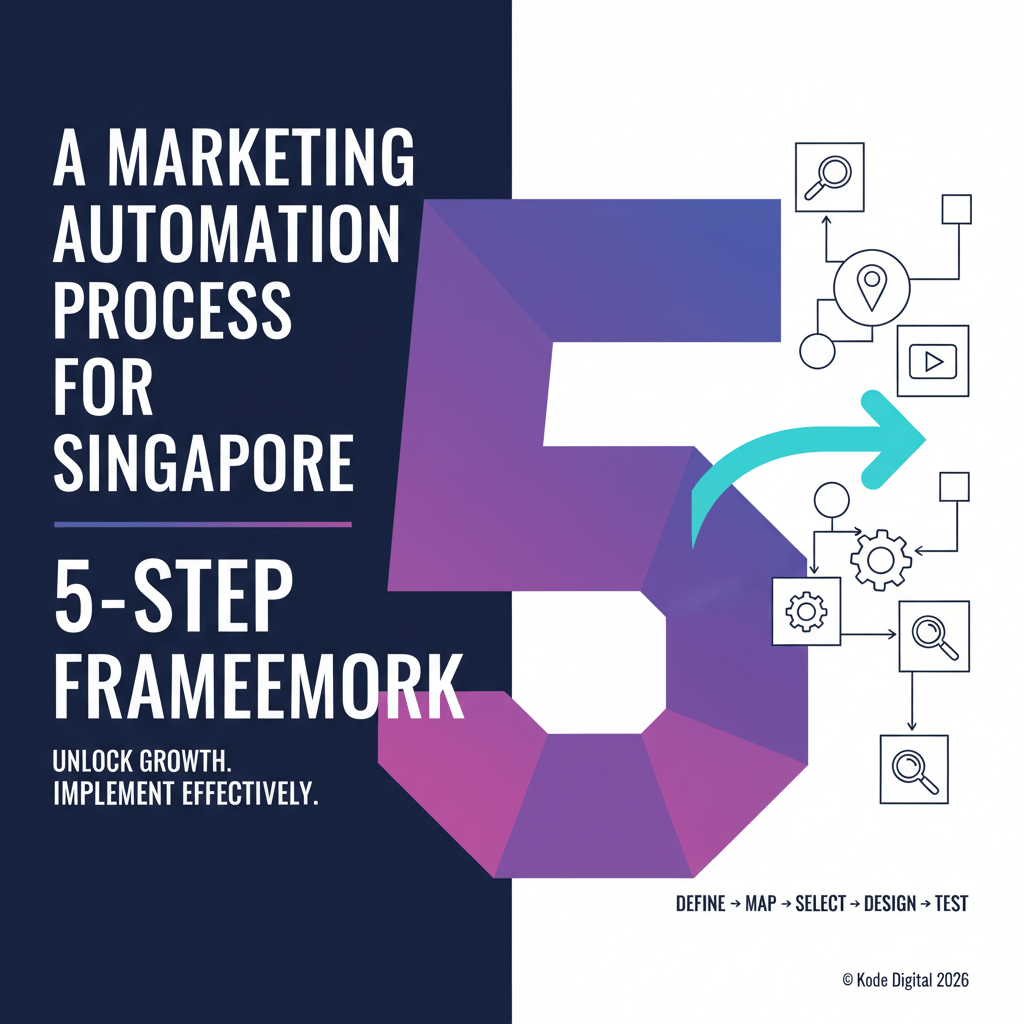
Marketing automation isn’t just about sending out bulk emails. It’s a sophisticated system that allows businesses to streamline, automate, and measure marketing tasks and workflows, ultimately enhancing operational efficiency and improving customer experiences. For any business operating in a dynamic market like Singapore, understanding how to systematically implement and optimise automation is key to staying competitive and achieving sustainable growth. Without a clear framework, businesses risk investing in technology that doesn’t deliver, or worse, alienating customers with poorly executed automated interactions. This guide provides a practical, five-step process to help you build an effective marketing automation strategy tailored for the Singapore market.
Step 1 — Define Your Goals and Audience Segments for Automation
Before you even think about software or campaigns, the foundational step is to clearly define what you want your marketing automation to achieve and who you’re trying to reach. This isn’t just about general business objectives; it’s about specific, measurable goals directly tied to your marketing efforts. Do you want to reduce customer churn by 15%? Increase repeat bookings for your chiropractic clinic by 20%? Improve lead qualification rates to save your sales team time? These clear targets will dictate the type of automation you need and how you’ll measure its success.
Equally crucial is understanding your audience. Singapore’s diverse consumer base means a one-size-fits-all approach is rarely effective. Segmenting your audience allows you to deliver highly relevant messages at the right time. Consider various demographic, behavioural, and psychographic factors unique to local consumers. For instance, new website visitors, existing customers who haven’t purchased in six months, or those who have shown interest in a specific service should each receive different, tailored communications. This requires delving into your existing customer data, conducting surveys, or analysing website behaviour. The more granular your segmentation, the more personalised your automated campaigns can be, significantly improving engagement and conversion rates. Without this clear understanding, your automation efforts will lack direction and impact.
Step 2 — Map the Customer Journey and Identify Automation Opportunities
Once your goals and audience segments are crystal clear, the next critical step is to visualise and map out the entire customer journey. This means tracing every potential interaction a customer might have with your brand, from their very first awareness of your offering right through to post-purchase engagement and loyalty. Think about the typical path a local consumer might take: perhaps they see an ad on social media, visit your website, sign up for a newsletter, make an enquiry, purchase a product, and then receive follow-up support.
For a business offering chiropractic services in the Singapore CBD, for example, a journey might look like this: a potential patient searches for ‘back pain relief Singapore’ on Google, lands on a blog post on your site, downloads a guide to improving posture, receives a series of educational emails, then books an initial consultation. After their appointment, they receive a follow-up email with exercises, and later a reminder for their next check-up.
By meticulously mapping these journeys, you can identify specific touchpoints where automation can add significant value. These are typically points where repetitive manual tasks occur, where timely communication is crucial, or where a nudge can move a customer further along their path. This might involve automating welcome email sequences for new subscribers, sending abandoned cart reminders, scheduling appointment confirmations and follow-ups, or triggering re-engagement campaigns for inactive customers. This step helps to pinpoint exactly where marketing automation will have the greatest impact, ensuring your efforts are focused and efficient. Working with a proficient digital agency Singapore can be invaluable in crafting these intricate customer journeys.
Step 3 — Select the Right Marketing Automation Technology and Ensure Data Integration
With a clear strategy in place, you’re ready to consider the tools that will bring it to life. Choosing the right marketing automation platform is paramount, and it’s not a decision to be taken lightly. The market offers a wide array of solutions, each with different features, scalability, and pricing models. For Singapore SMEs, it’s crucial to select a platform that aligns with your current needs while also being able to grow with your business. Look for tools that offer robust email marketing, lead nurturing, segmentation capabilities, and detailed analytics. Consider ease of use, local support options if available, and the potential for seamless integration with your existing systems.
Integration is often the most overlooked yet critical aspect of technology selection. Your marketing automation platform shouldn’t operate in a silo. It needs to communicate effectively with your CRM (Customer Relationship Management) system, your website’s CMS (Content Management System), your e-commerce platform, and potentially even your accounting software. Without proper data integration, your automation efforts will be fragmented, leading to inconsistent customer experiences and inaccurate data. Imagine a customer booking an appointment through your website only for your marketing automation system to send them a ‘first-time visitor’ discount email the next day – a disjointed experience that could easily be avoided. Ensure the platform you choose offers native integrations or has a well-documented API for custom connections. Prioritising smooth data flow ensures that your customer profiles are always up-to-date and your automated communications are always relevant. This step lays the groundwork for truly effective digital marketing Singapore.
Step 4 & 5 — Design & Implement Automated Workflows, Then Test and Optimise Relentlessly
Step 4: Design and Implement Your Automated Workflows
This is where your mapping from Step 2 truly comes to life. Based on your defined goals and customer journeys, you’ll begin building the actual automated sequences. A workflow is a series of automated actions triggered by a specific event or customer behaviour. For instance:
- Welcome Series: When a new user signs up for your newsletter via your web design Singapore form, they immediately receive a welcome email, followed by educational content over the next few days.
- Abandoned Cart Recovery: If a customer adds items to their online cart but doesn’t complete the purchase, a reminder email is sent after a few hours, perhaps with an incentive.
- Re-engagement Campaigns: For customers who haven’t interacted with your brand in a set period (e.g., 90 days), an automated email sequence can be triggered to prompt a return visit or purchase.
- Appointment Reminders and Follow-ups: Automatically send SMS or email reminders for upcoming appointments and post-service feedback requests, which is particularly useful for health and wellness businesses.
- Content Delivery: If a user downloads a specific whitepaper, automatically enrol them in a nurturing track related to that topic, delivering relevant content marketing Singapore directly to their inbox.
Each workflow needs clear triggers (e.g., ’email opened’, ‘form submitted’, ‘page visited’), conditions (e.g., ‘is a first-time customer’, ‘has not purchased in X days’), and actions (e.g., ‘send email’, ‘update CRM field’, ‘add to list’). Start simple, focusing on one or two high-impact workflows, then gradually expand.
Step 5: Test and Optimise Relentlessly
Implementing workflows is not the finish line; it’s just the beginning. The next crucial phase involves rigorous testing and continuous optimisation. Before going live, thoroughly test every sequence to ensure all triggers, conditions, and actions fire correctly. Send test emails to yourself, simulate different customer behaviours, and check all links and personalisation tokens.
Once live, monitor your campaigns’ performance closely. Pay attention to key metrics such as email open rates, click-through rates, conversion rates, and unsubscribe rates. Are your welcome emails generating the expected engagement? Is your abandoned cart sequence recovering sales effectively? Use A/B testing to experiment with different subject lines, call-to-actions, content variations, and send times. The digital landscape in Singapore is always evolving, so your automation strategy must be adaptable. Regularly review your data, identify areas for improvement, and iterate your workflows. This continuous feedback loop is essential for maximising your ROI and ensuring your automation remains effective and relevant. This iterative approach is fundamental to achieving high performance marketing Singapore results.
Leveraging AI for Advanced Marketing Automation and Future Readiness
The landscape of marketing automation is being profoundly transformed by Artificial Intelligence (AI). What was once a sophisticated rule-based system is now becoming an intelligent, self-optimising engine. For Singapore businesses, embracing AI in marketing automation isn’t just an advantage; it’s rapidly becoming a necessity to stay ahead.
AI introduces capabilities that elevate automation beyond basic workflow execution. Imagine predictive analytics that can identify which leads are most likely to convert, allowing your automation to prioritise and tailor messages for maximum impact. AI can also power hyper-personalisation, generating dynamic content variations based on individual user preferences and behaviour, making every interaction feel unique. Intelligent chatbots can provide instant, 24/7 customer support, answering queries and even qualifying leads before passing them to a human agent, streamlining the customer journey. Furthermore, AI tools can analyse vast datasets to uncover hidden patterns, optimising everything from email send times to the best channels for reaching specific segments on social media marketing Singapore. As businesses look to the future, integrating ai marketing Singapore capabilities into their automation strategy will be key to unlocking new levels of efficiency, personalisation, and competitive edge.
Please note: This article provides general information and does not constitute specific legal or compliance advice regarding local regulations such as the Personal Data Protection Act (PDPA). Businesses should consult with legal professionals to ensure full compliance.
Implementing a structured marketing automation process, from defining goals to leveraging AI, is no longer a luxury but a strategic imperative for businesses in Singapore. By following this five-step framework, you can move beyond manual drudgery and build a sophisticated, customer-centric system that drives consistent growth, frees up valuable resources, and deepens customer relationships. The future of effective marketing in Singapore is automated, intelligent, and highly personalised – are you ready to build yours?
