

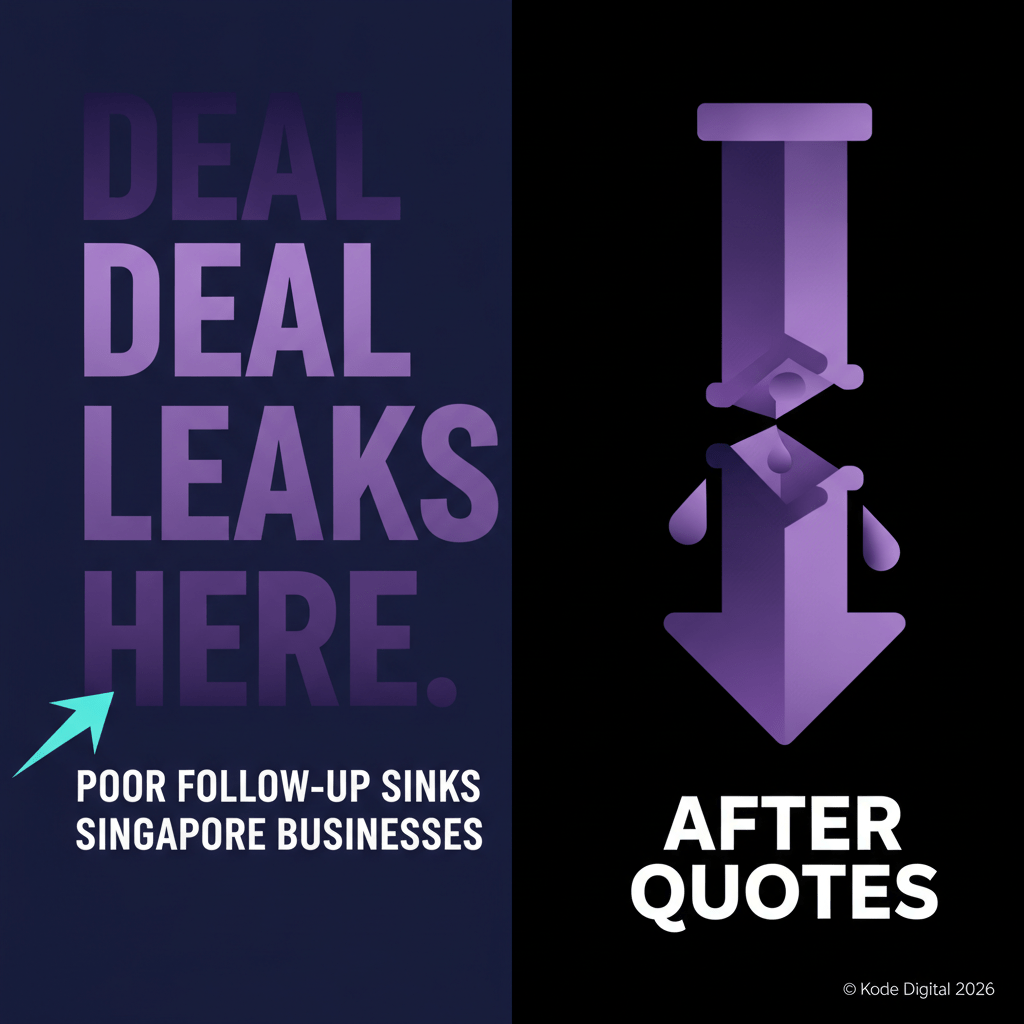
A business owner in the Singapore CBD spends two hours crafting a detailed proposal, sends it across, and then… waits. Days pass. No follow-up call. No check-in email. The prospect moves on and signs with someone else. It is one of the most common — and most preventable — ways Singapore businesses quietly bleed revenue.
The frustrating part is that this rarely happens because the quote was wrong or the price was too high. It happens because nobody followed up. And in a competitive market where prospects are weighing up multiple options at once, silence reads as disinterest.
What Your Team Is Actually Doing After They Send a Proposal
Most sales and account teams believe they are following up. Ask them directly and they will tell you they sent a follow-up email. What they often mean is they sent one email, received no reply, and mentally moved on — treating the silence as a rejection when it was almost certainly just noise.
Research consistently shows that the majority of deals require five or more touch points before a prospect commits. Yet most staff stop after one or two. In a market like Singapore, where decision-makers are juggling multiple vendors, procurement processes, and internal approvals, a single follow-up email rarely cuts through.
The problem is compounded when there is no shared system. One staff member follows up once. Another assumes a colleague has handled it. A third thinks the prospect “went cold.” Meanwhile, the proposal is sitting unread in an inbox and no one owns the outcome.
Why the Standard Approach Fails
Teams typically fall into a few predictable traps when it comes to quote follow-up.
- No defined follow-up timeline. Without a clear process — day one, day three, day seven — staff default to gut feeling, which usually means doing nothing after an initial email.
- Following up with the wrong message. “Just checking in” is not a follow-up. It adds no value, signals desperation, and gives the prospect no reason to respond. Good follow-up offers something: an answer to a likely question, a clarification, a relevant case point.
- Relying on memory instead of systems. When reminders live inside someone’s head rather than a CRM or task manager, they get dropped the moment that person has a busy week.
- Treating silence as a no. Silence almost always means busy, uncertain, or waiting for internal approval — not disinterested. Teams that treat silence as rejection exit conversations that were still very much alive.
- No accountability structure. If nobody reviews whether proposals are being followed up, nobody feels accountable for doing it consistently.
For any business working with a digital marketing agency Singapore to drive inbound leads, this is where the investment falls apart. You can generate all the enquiries in the world, but if follow-up is broken, the pipeline leaks from the top.
A Practical Follow-Up Framework That Actually Works
The goal is to build a repeatable, team-wide process — not depend on individual motivation. Here is a straightforward framework that Singapore businesses can apply immediately.
- Set the expectation at the point of sending. When you send a proposal, confirm a specific date and time you will follow up. “I will call you Thursday at 2pm to walk through any questions.” This removes ambiguity and creates a soft commitment from the prospect to be available.
- Build a three-touch minimum sequence. Day one: send the proposal with a brief summary of the key value points. Day three: a short, specific follow-up that addresses the most common question or objection for this type of client. Day seven: a final follow-up that adds something useful — a relevant insight, a comparison, or a simplified decision summary.
- Log every proposal in a shared system. Whether it is a CRM, a shared spreadsheet, or a project tool, every proposal must be visible to the team lead with a follow-up status attached. No dark corners where deals go to die quietly.
- Assign a single owner per proposal. Multiple people aware of a deal with no single owner is the same as nobody owning it. One person is responsible for moving it forward, and that is tracked weekly.
- Review open proposals in every sales meeting. Make it a standing agenda item. Which proposals have had no follow-up in the past seven days? What is blocking progress? This creates the accountability that prevents the process from quietly being abandoned.
How AI Is Changing the Follow-Up Game
AI tools are now doing something genuinely useful here: removing the need for staff to remember to follow up at all. Modern CRM platforms with built-in AI can automatically trigger follow-up reminders, flag proposals that have been sitting idle for too long, and even suggest the next best action based on where a prospect is in the pipeline.
Some platforms can analyse email open rates and engagement signals to tell your team whether a proposal has even been read — letting them prioritise their outreach intelligently rather than following up blindly. This is particularly valuable for businesses handling high volumes of quotes simultaneously.
Beyond reminders, AI-assisted tools can help staff draft better follow-up messages by analysing what has worked in previous successful deals. For businesses working with an seo agency Singapore or running paid campaigns through a web design Singapore partner, AI follow-up tools close the loop between marketing investment and actual conversion.
It is also worth noting the growing influence of platforms like XHS (Xiaohongshu) among Singapore’s Chinese-speaking consumer segments — XHS meaning different things to different audiences, but increasingly functioning as a discovery and trust-building channel. For B2C businesses especially, understanding where prospects first encountered your brand before requesting a quote helps contextualise the follow-up conversation and personalise the message more effectively.
How to Know If Your Business Is Ready to Fix This
Before overhauling your process, it helps to diagnose honestly where things currently stand. These are the signals that tell you the follow-up problem is real and worth prioritising:
- You have sent more than ten proposals in the past 90 days with no structured follow-up record
- Your close rate on quotes is below 30 per cent and you cannot identify why
- Staff regularly say prospects “went cold” but cannot explain the last touch point or its timing
- Proposals are being sent but there is no shared visibility across the team
- You have no follow-up sequence — just ad hoc emails sent when someone remembers
- You are investing in a digital marketing agency to generate leads but conversion rates are not reflecting that spend
If three or more of those apply, the issue is structural, not motivational. Telling staff to “follow up more” without giving them a process, a system, and accountability is unlikely to produce lasting change.
The Shift That Changes Everything
Businesses that fix their proposal follow-up rarely need to chase more leads. They simply convert more of the ones they already have. In Singapore’s business environment — where trust, responsiveness, and professionalism carry significant weight in purchasing decisions — consistent, well-timed follow-up is often the single factor that differentiates a business that wins the deal from one that does not.
The mechanics are not complicated. A clear timeline, a shared system, a single owner, and a standing review. What makes the difference is deciding that proposal follow-up is a process with standards, not a habit left to individual initiative.
Disclaimer: The frameworks and suggestions in this article are intended as general guidance only. Businesses should assess their own operational context before implementing changes to sales processes.
